
-
-
Save Hermann-SW/12c7644ac0c75b4eb019f76c3f023fe5 to your computer and use it in GitHub Desktop.
| This Python script became obsolete with this new repo: | |
| https://github.com/Hermann-SW/graphviz_latex_pipeline | |
| Because that repo's texdot.py compiles the LaTeX in each node or edge separately, with the real LaTeX. | |
| You can still access this gist's Python code by opening the file at earlier revisions. |

Execute:
$ python build_graph.py
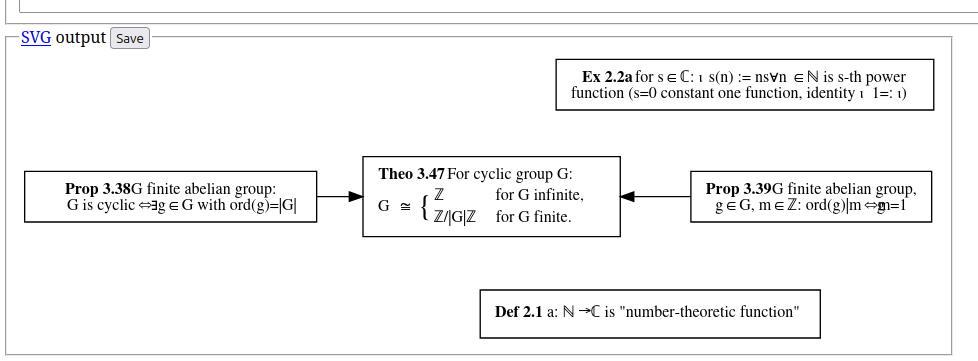
Generated .dot file:
digraph G {
layout=neato;
overlap=prism;
sep="+15";
node [shape=box, fontsize=12, margin="0.15,0.1"];
rankdir=LR
Def_2_1 [label=<<B>Def 2.1 </B>a: ℕ →ℂ is "number-theoretic function" >];
Ex_2_2a [label=<<B>Ex 2.2a </B>for s∈ℂ: ι<SUP>s</SUP>(n) := n<SUP>s</SUP> ∀n ∈ℕ is s-th power<BR/>function (s=0 constant one function, identity ι<SUP>1</SUP> =: ι)>];
prop_3_38 [label=<<B>Prop 3.38 </B>G finite abelian group:<BR/> G is cyclic ⇔∃g∈G with ord(g)=|G|>];
prop_3_39 [label=<<B>Prop 3.39 </B>G finite abelian group,<BR/>g∈G, m∈ℤ: ord(g)|m ⇔g<SUP>m</SUP>=1>];
theo_3_47 [label=<<TABLE BORDER="0" CELLBORDER="0" CELLSPACING="0" CELLPADDING="0"><TR><TD BORDER="0" ALIGN="LEFT" COLSPAN="2"><B>Theo 3.47 </B>For cyclic group G:</TD></TR><TR><TD BORDER="0" VALIGN="MIDDLE" ALIGN="LEFT"> G ≅ </TD><TD BORDER="0" VALIGN="MIDDLE" ALIGN="LEFT"><TABLE BORDER="0" CELLBORDER="0" CELLSPACING="0" CELLPADDING="1"><TR><TD ROWSPAN="2" VALIGN="MIDDLE" ALIGN="RIGHT" BORDER="0"><FONT POINT-SIZE="22">{</FONT></TD><TD ALIGN="LEFT" VALIGN="MIDDLE" BORDER="0">ℤ</TD><TD ALIGN="LEFT" VALIGN="MIDDLE" BORDER="0"> for G infinite,</TD></TR><TR><TD ALIGN="LEFT" VALIGN="MIDDLE" BORDER="0">ℤ/|G|ℤ</TD><TD ALIGN="LEFT" VALIGN="MIDDLE" BORDER="0"> for G finite.</TD></TR></TABLE></TD><TD BORDER="0" VALIGN="MIDDLE" ALIGN="LEFT"></TD></TR></TABLE>>];
{ prop_3_38 prop_3_39 } -> theo_3_47;
}
$
graph_output.pdf file gets created from created .dot file automatically:
$ ls -lst | head -2
total 13891660
     24 -rw-rw-r-- 1 hermann hermann      24281 Sep  3 17:24 graph_output.pdf
$
build_graph.py transpiles Latex "...^..." and "..._..." to "<SUP>...</SUP>" and "<SUB>...</SUB>" which works nicely in Graphviz HTML labels as seen above. Unfortunately SUP/SUB are not supported by viz-js from Mike Daines, so I created new issue:
mdaines/viz-js#409
Nice short script eg. allowing generation of new output in vi editor [my preferred editor since 1990 ;-)] while editing build_graph.py:
- press
:, thenwand<ENTER>to write changes - press
:, then!,Pand<ENTER>to run the script and update PDF viewer displayinggraph_output.pdf
$ cat /usr/local/bin/P
#!/bin/bash
python build_graph.py
$
build_graph.py does abort in case of an unknown macro and reports the macro name as well as the line number with the unknown macro (here when executed from within vi as described before):
Traceback (most recent call last):
  File "/home/hermann/Downloads/build_graph.py", line 248, in <module>
    def_label = latex_to_graphviz_html(
                ^^^^^^^^^^^^^^^^^^^^^^^
  File "/home/hermann/Downloads/build_graph.py", line 194, in latex_to_graphviz_html
    raise ValueError(f"Unknown macro \\{missing_node.macroname}")
ValueError: Unknown macro \mathBb

shell returned 1

Press ENTER or type command to continue
Latest gist output …
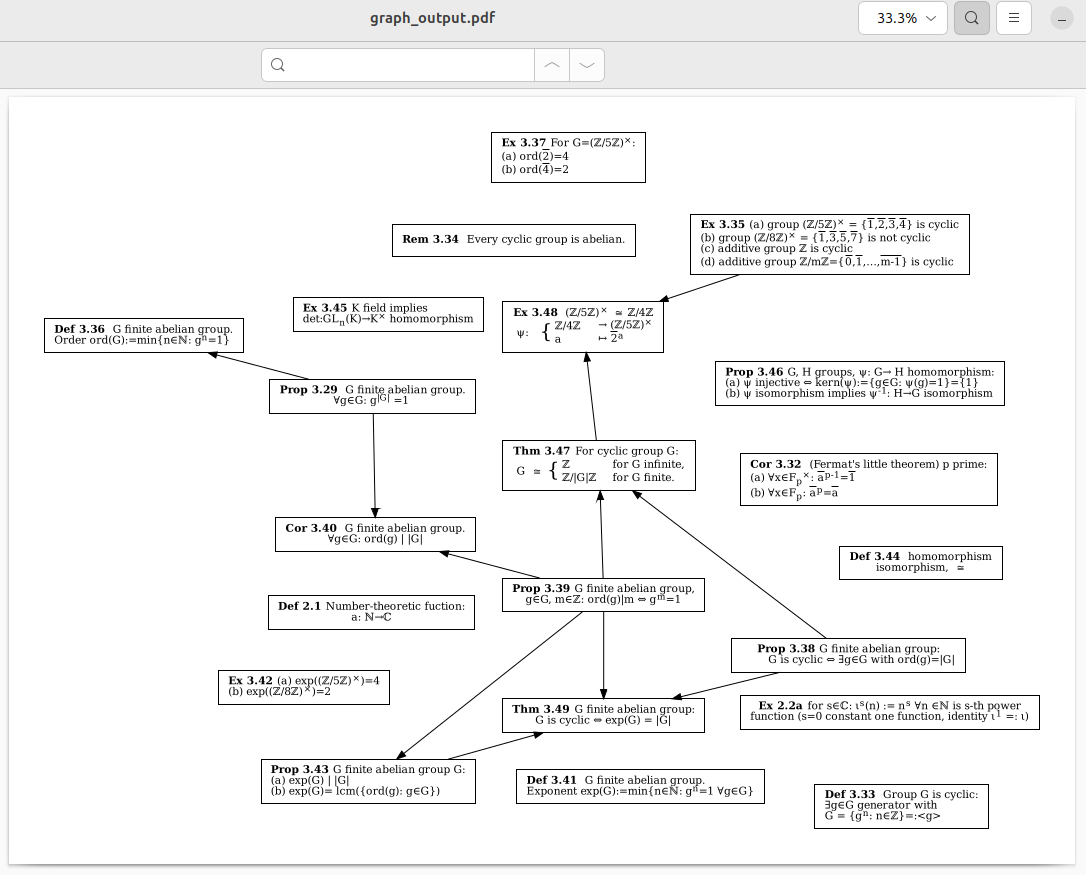
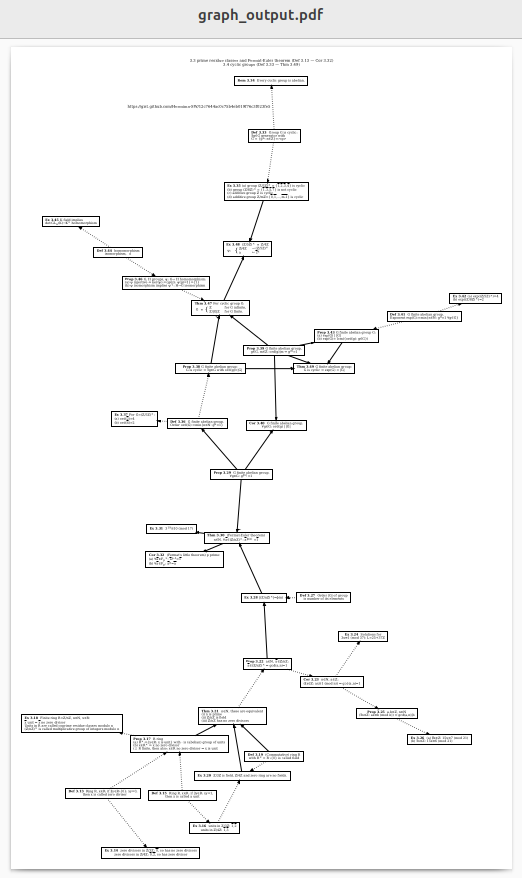
Added sections 3.3 “prime residue classes and Fermat-Euler theorem” and 3.4 “cyclic groups” of (German language) lecture script sitting behind Heidelberg University VPN. From definition 3.13 until theorem 3.49. More:
https://forum.graphviz.org/t/latex-labels-for-graphviz-work-in-progress/3402/3
Latest 10% screenshot below, full PDF for browser view:
https://stamm-wilbrandt.de/prime_residue_classess_and_Fermat-Euler_theorem.cyclic_groups.pdf
Unrelated, just for sharing AI markdown output:
TZCNT, LZCNT, shifts, and masks) without factoring.1. Fundamental Structural Invariants for $1 < n < 2^{64}$
-
Bounded Factor Counts:
-
Distinct primes ($k$): At most $k \le 15$, since the 16th primorial
$2 \cdot 3 \cdot 5 \cdots 53 \approx 3.26 \times 10^{19}$ exceeds$2^{64}$ . At most 14 distinct odd primes can divide$n$ .
-
Total multiplicity ($\Omega = \sum_{i=1}^k e_i$): At most $63$ (for
$2^{63}$ ), and at most $39$ odd prime factors counted with multiplicity (since$3^{40}$ exceeds$2^{64}$ ).
-
-
Factoring Out $2^{e_2}$: Write
$n = 2^{e_2} \cdot q_1 q_2 \cdots q_r$ , where$e_2 \ge 0$ is the exponent of$2$ , and$3 \le q_1 \le q_2 \le \dots \le q_r$ are the odd prime factors listed with multiplicity (sorted by non-decreasing bit-length). Once$q_1, \dots, q_r$ are unpacked in sorted order, grouping equal adjacent primes into$(p_i, e_i)$ takes a single pass of at most 39 comparisons ($O(1)$ ).
-
The Log-Sum Invariant ($\le 63$): For each odd prime
$q_j \ge 3$ , let$s_j = \lfloor \log_2 q_j \rfloor \ge 1$ be the bit index of its most significant bit. Because every odd prime satisfies$q_j \ge 2^{s_j} + 1$ , we have:$$2^{e_2 + \sum_{j=1}^r s_j} \le 2^{e_2} \prod_{j=1}^r q_j = n \le 2^{64} - 1 \implies e_2 + \sum_{j=1}^r s_j \le 63$$ -
The "Free MSB & LSB" Property of Odd Primes: Every odd prime
$q_j \ge 3$ has its most significant bit fixed to1(at bit$s_j$ ) and its least significant bit fixed to1(since it is odd):$$q_j = 2^{s_j} + 2 u_j + 1, \quad u_j \in \left[0, 2^{s_j - 1} - 1\right]$$ Thus, given$s_j$ ,$q_j$ is uniquely determined by only $s_j - 1$ interior bits$u_j$ . (Notably,$q_j = 3$ has$s_j = 1$ and requires 0 interior bits.) Summing over all odd prime factors:$$\text{Total interior bits } m = \sum_{j=1}^r (s_j - 1) = \left(\sum_{j=1}^r s_j\right) - r \le 63 - e_2 - r \le 62\text{ bits}$$
2. The Core Trick: Overlapping Primes in a Single 64-Bit Word W
1-bit (LSB) and ends with a 1-bit (MSB), we can chain $q_1, q_2, \dots, q_r$ end-to-end inside a single 64-bit word W (uint64_t) by overlapping the MSB 1-bit of $q_j$ with the LSB 1-bit of $q_{j+1}$!W by bitwise-ORing each odd prime shifted to its fencepost start:W gives you immediately in hardware:-
Bits $0 \dots P_0 - 1$ are
0, and bit $P_0$ is1: Therefore, the exponent of$2$ is extracted in 1 CPU cycle viae2 = P_0 = tzcnt(W)(count trailing zeros).
-
Bit $P_r$ is the highest set
1-bit ofW: Therefore,$P_r = 63 - \text{lzcnt}(W)$ is also extracted in 1 CPU cycle! (IfWhas only one set bit, i.e.(W & (W - 1)) == 0, then$r = 0$ and$n = 2^{e_2}$ .)
-
Every prime $q_j$ is sitting verbatim in
Wbetween bits $P_{j-1}$ and $P_j$: Once you know the fencepost positions$P_0, P_1, \dots, P_r$ , extracting$q_j$ is a single shift and mask:$$q_j = (\texttt{W} \gg P_{j-1}) \ \& \ \left((2 \ll (P_j - P_{j-1})) - 1\right)$$
W (64 bits) already holds $e_2$, $P_r$, and all interior bits of every prime factor. The only remaining information required to unpack the factorization is identifying which internal bit positions $P_1, \dots, P_{r-1}$ are the boundaries between primes.3. Three Optimal $O(1)$ Packing Schemes
W:Scheme | Bits per Number | Shared Lookup Table | O(1) Unpack Cost | Best Use Case -- | -- | -- | -- | -- A. Raw Fencepost Pair (W, F) | 126 bits (16 B aligned) | 0 bytes | ~15 CPU cycles (pure ALU/BMI2) | Zero cache pressure, SIMD-friendly B. W + Partition Shape ID | 80 bits (10 bytes) | ~2.4 MB | 1 table lookup + ~15 ALU cycles | Best balance of high density & simplicity C. Slack-Shared + Wheel-30 | 72 bits (9 bytes) | ~4.5 MB | 2 table lookups + ~25 ALU cycles | Maximum practical $O(1)$ bit density
Scheme A: Zero-Table 126-Bit Packing (W + Fencepost Mask F)
(W, F):-
W(uint64_t, 64 bits): The overlapped prime word defined above.
-
F(uint64_t, 62 bits): A bitmask with1s at the internal fenceposts$P_1, P_2, \dots, P_{r-1}$ (since$P_0$ and$P_r$ are already the lowest and highest set bits ofW, bits$0$ and$63$ ofFare never needed, using at most 62 bits).
#include <stdint.h>typedef struct {
uint64_t p;
uint8_t e;
} PrimePower;// Unpacks n's prime factorization in O(1) time with ZERO lookup tables
int unpack_factorization_126(uint64_t W, uint64_t F, PrimePower out[15]) {
int k = 0;
int p0 = __builtin_ctzll(W); // Exponent of 2 (P_0)
if (p0 > 0) {
out[k++] = (PrimePower){2, (uint8_t)p0};
}
// Clear lowest fencepost bit P_0; remaining bits in F | (1ULL << P_r) mark odd primes
uint64_t fences = F;
int prev = p0;
uint64_t last_prime = 0;<span class="hljs-keyword" style="font-family: Google Sans Text, sans-serif !important; line-height: 1.15 !important; margin-top: 0px !important; margin-left: 0px !important; margin-right: 0px !important;">while</span> (fences != <span class="hljs-number" style="font-family: Google Sans Text, sans-serif !important; line-height: 1.15 !important; margin-top: 0px !important; margin-left: 0px !important; margin-right: 0px !important;">0</span>) { <span class="hljs-keyword" style="font-family: Google Sans Text, sans-serif !important; line-height: 1.15 !important; margin-top: 0px !important; margin-left: 0px !important; margin-right: 0px !important;">int</span> next = __builtin_ctzll(fences); fences &= fences - <span class="hljs-number" style="font-family: Google Sans Text, sans-serif !important; line-height: 1.15 !important; margin-top: 0px !important; margin-left: 0px !important; margin-right: 0px !important;">1</span>; <span class="hljs-comment" style="font-family: Google Sans Text, sans-serif !important; line-height: 1.15 !important; margin-top: 0px !important; margin-left: 0px !important; margin-right: 0px !important;">// Clear lowest set fencepost</span> <span class="hljs-keyword" style="font-family: Google Sans Text, sans-serif !important; line-height: 1.15 !important; margin-top: 0px !important; margin-left: 0px !important; margin-right: 0px !important;">int</span> s = next - prev; <span class="hljs-keyword" style="font-family: Google Sans Text, sans-serif !important; line-height: 1.15 !important; margin-top: 0px !important; margin-left: 0px !important; margin-right: 0px !important;">uint64_t</span> q = (W >> prev) & ((<span class="hljs-number" style="font-family: Google Sans Text, sans-serif !important; line-height: 1.15 !important; margin-top: 0px !important; margin-left: 0px !important; margin-right: 0px !important;">2ULL</span> << s) - <span class="hljs-number" style="font-family: Google Sans Text, sans-serif !important; line-height: 1.15 !important; margin-top: 0px !important; margin-left: 0px !important; margin-right: 0px !important;">1ULL</span>); <span class="hljs-keyword" style="font-family: Google Sans Text, sans-serif !important; line-height: 1.15 !important; margin-top: 0px !important; margin-left: 0px !important; margin-right: 0px !important;">if</span> (q == last_prime) { out[k - <span class="hljs-number" style="font-family: Google Sans Text, sans-serif !important; line-height: 1.15 !important; margin-top: 0px !important; margin-left: 0px !important; margin-right: 0px !important;">1</span>].e++; } <span class="hljs-keyword" style="font-family: Google Sans Text, sans-serif !important; line-height: 1.15 !important; margin-top: 0px !important; margin-left: 0px !important; margin-right: 0px !important;">else</span> { out[k++] = (PrimePower){q, <span class="hljs-number" style="font-family: Google Sans Text, sans-serif !important; line-height: 1.15 !important; margin-top: 0px !important; margin-left: 0px !important; margin-right: 0px !important;">1</span>}; last_prime = q; } prev = next; } <span class="hljs-keyword" style="font-family: Google Sans Text, sans-serif !important; line-height: 1.15 !important; margin-top: 0px !important; margin-left: 0px !important; margin-right: 0px !important;">return</span> k;
}
Scheme B: The 80-Bit (10-Byte) "Partition Index" Packing
F as a raw 64-bit bitmask in Scheme A wastes space:-
From
Walone, we already know both$P_0 = \text{tzcnt}(W)$ and$P_r = 63 - \text{lzcnt}(W)$ , so we already know the exact sum of the step sizes:$$S = \sum_{j=1}^r s_j = P_r - P_0 \in [0, 63]$$ -
Because multiplication is commutative, we sort the odd prime factors so that their step sizes are non-decreasing:
$$1 \le s_1 \le s_2 \le \dots \le s_r, \quad \sum_{j=1}^r s_j = S$$ Therefore,$(s_1, s_2, \dots, s_r)$ is simply an integer partition of $S$!
-
How many partitions of
$S$ can actually correspond to valid primes with$\prod_{j=1}^r q_j < 2^{64 - e_2}$ ?
Every prime with$\lfloor \log_2 q_j \rfloor = s_j$ is at least$p_{\min}(s_j) = \text{next_prime}(2^{s_j})$ , which carries a mandatory fractional bit-excess$\delta_{\min}(s_j) = \log_2(p_{\min}(s_j)) - s_j$ :-
$s = 1 \ (q \ge 3) \implies \delta_{\min}(1) = \log_2(3) - 1 \approx 0.585\text{ bits}$
-
$s = 2 \ (q \ge 5) \implies \delta_{\min}(2) = \log_2(5) - 2 \approx 0.322\text{ bits}$
-
$s = 3 \ (q \ge 11) \implies \delta_{\min}(3) = \log_2(11) - 3 \approx 0.459\text{ bits}$
For a partition of$S$ to be realizable by a product under$2^{64}$ , the sum of these excesses must satisfy$\sum_{j=1}^r \delta_{\min}(s_j) < 64 - S - e_2$ .-
When
$S$ is near$63$ ,$64 - S$ is tiny, which eliminates almost all partitions containing small parts ($1, 2, 3$ ).
-
When
$S$ is small, the unconstrained partition number$p(S)$ is already small.
Consequently, for every$S \in [1, 63]$ , the number of realizable partitions of$S$ is strictly less than $2^{16} = 65,536$!
-
-
Bytes 0–7 (
uint64_t W): The 64-bit overlapped prime word.
-
Bytes 8–9 (
uint16_t shape_idx): The 16-bit index of the partition$(s_1, \dots, s_r)$ within the precomputed tablePARTITION_FENCES[S][shape_idx], which directly returns the 64-bit relative fencepost maskF_relin a single memory lookup!
-
Decoding: Compute
e2 = tzcnt(W),S = (63 - lzcnt(W)) - e2, fetchF = PARTITION_FENCES[S][shape_idx] << e2, and run the exact same loop as Scheme A.
Scheme C: Pushing to 72 Bits (9 Bytes) via Slack Sharing & Wheel-30
-
Exploit the $63 - S + r$ Slack inside
W:
When a number has many prime factors ($r$ is large, so the number of possible partitions is larger), the actual number of interior bits$m = \sum_{j=1}^r (s_j - 1) = S - r$ shrinks by$r$ . Conversely, when$m$ is near$62$ ($r = 1$ or$2$ ), there are fewer than$35$ possible partitions. By packing the$m$ interior bits in the low bits of a 72-bit integer and storing a combined(e2, partition_id)state in the upper$72 - m$ bits, every valid(shape, interior_bits)combination across$1 < n < 2^{64}$ maps into fewer than$2^{72}$ states.
-
Wheel-30 Compression ($W_{30}$):
Every prime$q \ge 7$ lies in one of$\phi(30) = 8 = 2^3$ residue classes modulo 30:${1, 7, 11, 13, 17, 19, 23, 29}$ . Writing$q = 30 m_q + \text{WHEEL30}[c]$ (where$c \in {0..7}$ ) and encoding$(m_q \ll 3) \mid c$ shrinks each prime$q \ge 7$ by a factor of$30/8 = 3.75$ , saving an extra $\log_2(3.75) - 1 \approx 0.907$ bits per prime factor beyond LSB stripping and decoding in two instructions:(q_idx >> 3) * 30 + WHEEL30[q_idx & 7].
Bonus Case: If $n$ Itself Is Already Stored (64-Bit Key + 32-Bit Hint)
-
Never store the largest prime factor $q_r$ in the hint.
-
Store only
$q_1, \dots, q_{r-1}$ (which all satisfy$q_j < 2^{32}$ and$\prod_{j=1}^{r-1} q_j \le n / q_r$ ), and recover the final prime factor via a single 64-bit division:$$q_r = \frac{n}{2^{e_2} \prod_{j=1}^{r-1} q_j}$$
Interactive Bit-Packing Inspector
W, and paired with its fencepost mask F and 16-bit partition index:Key takeaway: Because the MSB and LSB of every odd prime are both1, chaining the primes insideWwith overlapped endpoints means a single 64-bit word already stores $e_2$, the total bit-span $S$, and all interior bits of every prime factor—reducing the remaining metadata to a 16-bit partition index (80 bits total) or a 62-bit fencepost mask (126 bits with zero tables).
Short answer:
The only representation that guarantees O(1) retrieval of the full factorisation for every 64‑bit integer is to store the integer itself (i.e., the 64‑bit value of n). Any “compact” encoding that tries to keep the factorisation in fewer bits must either
- allocate space for the worst‑case factorisation (which ends up using at least as many bits as the original 64‑bit number), or
- give up the O(1) guarantee and factor the number on‑the‑fly.
Below is a more detailed explanation of why this is the case and what the theoretical limits are.
1. What does “O(1) access” mean here?
O(1) means that, given a pointer/identifier for a stored factorisation, you can retrieve the complete list of primes, exponents, and their count in a constant number of steps – independent of the size of n or the number of prime factors k.
To achieve that, the representation must provide random‑access to each component (the count k, each prime pᵢ, each exponent eᵢ) without any computation that depends on n.
The only way to have true random‑access to an arbitrary‑length list inside a fixed‑size memory layout is to reserve space for the maximum possible length and keep the data contiguous (or in a small fixed‑size array).
If the layout is variable‑length (e.g., a linked list, a dynamically‑sized array, or a compressed stream), you need to follow pointers or decode a variable‑length format – both of which are O(k) (or worse) where k is the number of prime factors.
2. How many prime factors can a 64‑bit number have?
The product of the first m distinct primes (the primorial #pₘ) grows roughly like e^{pₘ}.
We need the largest m such that the primorial is still < 2⁶⁴ ≈ 1.84 × 10¹⁹.
| m | Primes (first m) | Primorial | ≈ log₂ |
|---|---|---|---|
| 1 | 2 | 2 | 1 |
| 2 | 2·3 | 6 | ≈ 2.6 |
| 3 | 2·3·5 | 30 | ≈ 4.9 |
| 4 | 2·3·5·7 | 210 | ≈ 7.7 |
| 5 | 2·3·5·7·11 | 2310 | ≈ 11.2 |
| 6 | 2·3·5·7·11·13 | 30030 | ≈ 14.9 |
| 7 | 2·3·5·7·11·13·17 | 510510 | ≈ 19 |
| 8 | …·19 | 9699690 | ≈ 23.2 |
| 9 | …·23 | 223092870 | ≈ 27.7 |
| 10 | …·29 | 6469693230 | ≈ 32.6 |
| 11 | …·31 | 200560490130 | ≈ 37.5 |
| 12 | …·37 | 7420738134810 | ≈ 42.8 |
| 13 | …·41 | 304250263527210 | ≈ 48.1 |
| 14 | …·43 | 13082761331670030 | ≈ 53.6 |
| 15 | …·47 | 614889782588491410 | ≈ 59.2 |
| 16 | …·53 | 32589158477190044730 | ≈ 64.9 > 2⁶⁴ |
Thus the maximum number of distinct prime factors for any integer < 2⁶⁴ is 15 (the primorial of the first 15 primes is still below 2⁶⁴; adding the 16‑th prime pushes it over).
In the absolute worst case for a prime number, k = 1 and the single prime can be as large as 2⁶⁴ − 1, requiring the full 64 bits just to store that prime.
3. Lower bound on any O(1) representation
Because a prime close to 2⁶⁴ must be representable, any format that allows O(1) retrieval of the factorisation must be able to store a 64‑bit value.
Consequently:
- Minimum worst‑case size = 64 bits (plus a few bits for metadata such as k).
- Storing the original number n already meets this lower bound.
Therefore no representation can be denser than “store the 64‑bit integer itself.”
Any attempt to “pack” the primes and exponents more tightly would have to sacrifice either:
- the ability to represent every possible 64‑bit prime (you would run out of bits), or
- the O(1) random‑access property (you would need to decode a variable‑length structure).
4. What if you are willing to reserve space for the worst‑case factorisation?
If you insist on a fixed‑size structure that always holds the full factorisation (so you can retrieve it in O(1) without any computation), you must allocate room for the maximum possible values of each field:
| Field | Maximum needed bits | Reasoning |
|---|---|---|
| k | 4 bits (values 0–15) | at most 15 distinct primes |
| Prime pᵢ | 64 bits each | a single prime can be a 64‑bit number |
| Exponent eᵢ | 6 bits each (0–63) | 2⁶⁴ ⇒ max exponent for base 2 is 64, so 6 bits suffice |
If you allocate 15 slots (the worst‑case k), the raw storage would be:
15 × (64 bits prime + 6 bits exponent) = 15 × 70 = 1050 bits
≈ 132 bytes
plus a few bits for k and possible padding → ≈ 136 bytes per number.
That is more than twice the size of simply storing the original 8‑byte integer.
Even if you compress the primes (e.g., by delta‑encoding relative to the previous prime) you would still need extra bits for the encoding scheme, and the worst‑case (a single 64‑bit prime) would still occupy essentially the same 64 bits.
Hence, a densest‑possible O(1) layout is still larger than the original 64‑bit value.
5. Practical recommendation
| Goal | Best approach |
|---|---|
| Minimal storage, O(1) lookup of the value (not the factorisation) | Store the 64‑bit integer n directly. Factorization can be done on demand (trial division, Pollard‑Rho, etc.) – not O(1) but very fast for a single number. |
| Guaranteed O(1) retrieval of the full factorisation | Keep a pre‑computed table that maps each 64‑bit n to its factorisation. The table entry must be at least 64 bits (to hold the prime) plus overhead, so the overall space consumption is essentially the same as storing the numbers themselves, often much larger due to indexing. |
| Space‑critical applications where occasional factorisation is acceptable | Store only the 64‑bit n and factor lazily when needed. Use a cache for frequently‑used numbers if the same factorisation is required repeatedly. |
| If you truly need both extreme density and O(1) factorisation | This is impossible under the given constraints; you must trade one of the two properties. |
6. TL;DR
The densest possible representation that still lets you read the complete factorisation in constant time must be able to hold a 64‑bit prime, so it needs at least 64 bits per entry. The simplest way to meet that lower bound is to store the original 64‑bit integer itself. Any “compact” encoding that tries to store primes and exponents separately either wastes more space (when you reserve room for the worst case) or cannot guarantee O(1) access.
In short: store the number; factor it on demand—or accept a much larger fixed‑size record if you truly require O(1) factorisation for every entry.
Work in progress, but does some nice stuff already.
(many many iterations working with gemini.google.com)
Below is the rendered
graph_output.pdf, with Latex cases environment already working!