
The Zodiac, 57 Years On: What the Primary Record Actually Supports — and Why Every "Solution," Including the AI One, Fails the Same Test
Pantheon Investigations · June 6, 2026
The Zodiac Killer is the most LLM-laundered unsolved case in America: roughly sixty years of theorist books, cipher "decodes," named suspects, and viral aggregator amplification have piled up to the point where an AI asked about the case will confidently repeat claims that collapse the moment you ask for a primary source. We ran the case through our standard discipline — for every claim, what is the primary source? — and the picture that survives is smaller, harder, and more honest than any of the famous solutions.
Four confirmed attacks (Dec 1968 – Oct 1969), five dead, two survivors, and a five-year mailed correspondence signed "the Zodiac" containing four cryptograms. Two of those ciphers are genuinely solved at FBI-confirmed tier; two are too short to be solvable at all, which is the single most important technical fact in the case and the one that defeats every "I decoded it and it names ___" claim — including the December 2025 announcement, made with an AI tool, that a 13-character cipher names a Black Dahlia suspect — the Black Dahlia being the still-unsolved 1947 Los Angeles murder of Elizabeth Short — and proves the Zodiac and the Dahlia killer were the same man. That claim fails at four independent structural points, and we walk through each.
The deeper finding is structural: across eight men publicly named as the Zodiac in sixty years, not one is tied to a single victim by a single piece of verified evidence. The case is a star around an empty center. The strongest-supported named suspect, Arthur Leigh Allen, leads the field — but "leads the field" tops out at an internal weight of roughly 0.10–0.25 (a 0-to-1 belief-share — see How to read this report just below), and the largest share of probability by far belongs to an unknown offender (~0.50–0.75). We adjudicate this case. We do not name the Zodiac, because the record does not.
Methodology: Pantheon Investigations uses Claude (Anthropic) for primary-source identification, synthesis, and drafting. The human operator handles final editorial control, fact-checks against primary sources before publication, and is accountable for any errors. All citations are independently verifiable; methodology is contestable in comments.
Corrections welcomed: if you can show a citation is wrong, a date or image ID is off, or a source is stronger than we credited it, we will correct it — in the comment thread and in the document itself.
A 20-second key to the two conventions we use throughout. Skip if you just want the story.
Source tiers — how well-established a claim is:
- VERIFIED — confirmed by a primary record (a court/government/agency document, a contemporaneous newspaper, or physical evidence). Stated as fact.
- REPORTED — asserted by a named, identifiable source (a witness, an official, a period news account) but not independently confirmed. Attributed, not adopted — "the surviving victim said…", "police believed, never proved…".
- UNVERIFIED — in circulation, but we could not trace it to a primary source.
- REFUTED-pending — a popular claim with NO citable primary source. We treat it as disproven unless and until someone produces the source. The stronger variant, "refuted-pending by structural principle," means the claim can't be proven even in theory — e.g. a 13-character cipher is mathematically too short for any "solution" to be unique, so no decode of it can ever be valid.
- "Agency tier" / "agency-confirmed" — a statement or finding from a law-enforcement agency (the FBI, a police department). The highest-confidence source short of physical proof.
Probability bands — how we express confidence:
- Each hypothesis gets a band (e.g. "0.10–0.25"), never a single false-precise number. Read these as 0-to-1 belief-shares that sum to roughly 1 across each table — how we would divide 100% of our belief among the competing explanations. The width of the range is the honest size of our own uncertainty about that number.
- We always include an explicit "unknown / residual" share — the case may exceed what the surviving record can resolve, and we say so rather than forcing a verdict. In this case, that residual turns out to be the largest share of all.
If you already know the Zodiac case, skip to "The Honest Ceiling." This section assumes zero prior knowledge.

What happened. Between December 1968 and October 1969, an unidentified man attacked four times in the San Francisco Bay Area — each attack in a different police jurisdiction — killing five people and leaving two who survived. Beginning in the summer of 1969 he started mailing letters to Bay Area newspapers, taunting police, claiming the murders, signing himself "the Zodiac," and marking his letters with a crossed-circle symbol (a circle with a cross through it, like a gun-sight). He enclosed four cryptograms — coded messages — and dared police to crack them. He was never caught, never identified, and the letters trailed off by the mid-1970s. The crossed-circle, the ciphers, and the theatrical correspondence turned an unsolved multiple murder into a sixty-year cultural obsession.
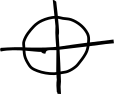


Why it's contested. Three features made the case a permanent magnet for theories. First, the ciphers invite anyone with a pencil (or now an algorithm) to claim they've "solved" it and unmasked the killer. Second, the letters mean the offender narrated his own case, which both confirms a great deal and contaminates it with his own boasts (he claimed "37" victims; investigators confirm five). Third, the case is officially open, so there is no authoritative answer to push back against the theories — and over six decades dozens of books and amateur investigators have each "solved" it, naming a different man every time.
How to read what follows. Our method is not to pick a favorite suspect and argue for him. It is to ask, for every claim, what is the primary source? — the contemporaneous newspaper, the police statement, the FBI confirmation, the court record — and to keep "no source" claims out of the evidence base. That discipline does two things here: it clears away most of the noise, and it exposes a hard structural fact that no "solution" has ever overcome.
The confirmed victims (public-record crime victims, named factually):
- David Faraday (17) & Betty Lou Jensen (16) — high-school students shot at a rural turnout on Lake Herman Road, Dec 20 1968. Both killed. The first confirmed attack.
- Darlene Ferrin (22) & Michael Mageau (19) — attacked in a parked car at Blue Rock Springs Park, Vallejo, July 4 1969. Ferrin killed; Mageau survived (d. 2018).
- Cecelia Shepard (22) & Bryan Hartnell (20) — stabbed at Lake Berryessa, Sept 27 1969, by an offender in a hooded costume. Shepard died of her wounds; Hartnell survived (living).
- Paul Stine (29) — San Francisco cab driver shot in Presidio Heights, Oct 11 1969. The fourth and last confirmed attack.
The men publicly named as suspects over sixty years (all deceased; assessed on the public record, none identified as the Zodiac):
- Arthur Leigh Allen (d. 1992) — Vallejo resident, the primary historical suspect; basis is a 1971 tip, suspect interviews, and circumstantial fit. The strongest-supported name — and still not a match.
- Gary Francis Poste (d. 2018) — named in 2021 by a group called the Case Breakers; rejected by the FBI and multiple police departments.
- Lawrence "Larry" Kane, Richard Gaikowski, Ross Sullivan (d. 1977) — each rests on a single witness's tentative recognition or descriptive coincidence.
- Marvin Margolis (d. 1993) — a Black Dahlia suspect swept into the Zodiac case by a December 2025 AI-aided cipher claim.
- Earl Van Best Jr. and Theodore Kaczynski (the "Unabomber," d. 2023) — both explicitly excluded by agency-tier evidence; carried only to document the refutation.
The theory-authors and researchers we evaluate (living; critiqued at standard, never accused): Alex Baber (the 2025 AI-cipher claim), the Case Breakers / Tom Colbert, Tom Mauriello, plus the cipher-research community (David Oranchak and colleagues, who solved the hard cipher and whom we rely on).
Domain terms, glossed once:
- Cryptogram / cipher — a message written in code. The Zodiac sent four, named by their character counts: Z408 (408 symbols), Z340 (340), Z13 (13), Z32 (32).
- Homophonic cipher — the type the Zodiac used: each plaintext letter can be represented by several different symbols, which is what made them hard.
- Marauder vs. commuter — a geographic-profiling distinction: a marauder attacks outward from his home base; a commuter travels away from home to offend. It describes spatial pattern, not personality. (A strategic-dispersal marauder — a term we use in Part 6 — is still a home-based offender, just one who deliberately spreads his attacks across police jurisdictions to hinder coordination.)
- Dec 20 1968 — Lake Herman Road: Faraday & Jensen killed (Solano County).
- Jul 4–5 1969 — Blue Rock Springs: Ferrin killed, Mageau survives (Vallejo). ~40 minutes later the offender phones Vallejo PD from a payphone two blocks from police headquarters, claiming this attack and the prior one.
- Jul 31–Aug 1 1969 — The first letters: three nearly identical mailings to the Vallejo Times-Herald, SF Chronicle, and SF Examiner, each enclosing one-third of the Z408 cipher and demanding front-page printing under threat of more killings if the papers refused — split so that no one paper held the whole cipher.
- Aug 4 1969 — The "This is the Zodiac speaking" letter; the name enters the record.
- Aug 8 1969 — A Salinas schoolteacher, Donald Harden, and his wife Bettye crack Z408 (it contains no name).
- Sept 27 1969 — Lake Berryessa: Shepard & Hartnell stabbed by a hooded offender, who writes the crossed-circle symbol and three attack dates on the door of Hartnell's car, then phones Napa County SO from downtown Napa.
- Oct 11 1969 — Stine killed in San Francisco. Oct 13: the offender mails a piece of Stine's bloodstained shirt to the SF Chronicle with a letter claiming the murder.
- Oct–Nov 1969 — Eyewitness composite of the suspect published; the unsolved Z340 cipher is mailed.
- 1969–1974 — ~20–21 letters and cards in total; the correspondence tapers off.
- Dec 5 2020 — Z340 is solved by an international team of codebreakers; the FBI confirms the solution Dec 11 2020.
- Oct 2021 — The Case Breakers publicly name Gary Francis Poste; agencies reject it.
- Apr 17 2026 — At a "Hamptons Whodunit" event, Alex Baber announces an AI-aided decode of the 13-character Z13 cipher naming a Black Dahlia suspect, Marvin Margolis.
The fuller story of what the offender actually did — the part the summary above only names. Survivor and witness accounts are attributed as such; everything else is contemporaneous public-record fact. (Skip ahead if you already know the case.)
Lake Herman Road — December 20, 1968. David Faraday and Betty Lou Jensen, on what was reportedly a first date, drove out to a gravel turnout on a dark rural road outside Vallejo — a known local lovers' lane. Shortly after 11 p.m., another car joined them in the dark. The attacker came at the car on foot. Jensen ran and was shot in the back as she fled; Faraday was shot in the head at close range, still near the car. Both were dead before anyone arrived. Nothing was stolen and neither was assaulted — the sheer absence of an ordinary motive is what left investigators with nothing to pull on, and what the killer's later letters would exploit.
Blue Rock Springs — July 4–5, 1969. Almost seven months later, Darlene Ferrin and Michael Mageau were parked in a lot at a park barely two miles from the first killings. A second car pulled in behind them, sat a moment, drove off — then came back. A man walked up to the passenger side with a bright flashlight and a 9mm pistol and fired through the window, hitting both, walked back toward his car, and — hearing them still moving — returned to fire again. Ferrin died; Mageau, gravely wounded, survived and lived until 2018. About forty minutes later, a man telephoned the Vallejo police from a payphone two blocks from headquarters, flatly claimed this attack and Lake Herman Road, and hung up. (Mageau's account is the source for the flashlight and the two-pass shooting.)
Lake Berryessa — September 27, 1969. This is the one attack in which the offender showed himself at length. Cecelia Shepard and Bryan Hartnell were picnicking by the lake when a man approached wearing a black executioner-style hood with a white crossed-circle symbol on the chest and a gun on his hip. By Hartnell's account, the man claimed to be an escaped convict who needed their car and money to get to Mexico, produced precut lengths of cord, had Shepard tie Hartnell and then bound her himself — and then stabbed them both repeatedly in the back. Shepard died of her wounds; Hartnell survived to describe the costume and the dialogue. Before leaving, the attacker wrote the crossed-circle symbol and the dates of all three attacks on the door of Hartnell's car, then phoned the Napa County sheriff from a payphone downtown. That car-door writing — listing attacks in a sequence only the killer could have known — is the single hardest proof that the letter-writer and the attacker were the same man.
Paul Stine — October 11, 1969. The last confirmed attack dropped the lovers'-lane pattern entirely. Stine, a San Francisco cab driver, picked up a fare and was directed into Presidio Heights, an affluent residential district. There the passenger shot him once in the head, took his wallet and keys, and tore away a piece of his bloodstained shirt. Across the street, teenagers watching from a window saw part of it happen and called police; responding officers reportedly passed a man walking calmly away near the scene. Two days later, the offender mailed the torn shirt fragment to the San Francisco Chronicle with a letter claiming the murder — authorship proven in blood. There were no further confirmed attacks. The killing stopped; the letters went on for years.
We lead with the limits, not the claims, because that is the brand's credibility test.
This case cannot be closed at the public-record tier. Every item that would actually discriminate between explanations sits behind an institutional or forensic wall:
- A clean offender DNA profile. The only physical genetic material attributed to the Zodiac is a thin partial profile recovered in 2002 from the outside of a stamp on a 1969 card — provenance-contested as possibly belonging to a postal handler rather than the killer (the contamination critique is documented by longtime Zodiac researcher Tom Voigt of zodiackiller.com; more in Part 5). A clean stamp-saliva profile with enough markers to individuate would likely settle the case. It does not publicly exist.
- The two unsolved ciphers (Z13, Z32) — and, critically, they may not be solvable at all (Part 4). If they encode a name, no method can prove it.
- The agency files — FBI, SFPD, Vallejo PD, Napa County SO, Riverside PD — including suspect-interview transcripts, the 1971 tip that put Allen on the map, and dispatch logs. Largely inaccessible at the public tier.
A tier note you should hold throughout. The confirmed-crime spine of this case — the four attacks, who died, who survived, the phone calls, the hooded costume, the shirt fragment — is now anchored to contemporaneous 1968–69 newspaper front pages across multiple independent counties (we did that sweep; see Part 3). That is solid. But the case against any particular suspect rests on tips, witness recognitions, and interview material we have not independently inspected — and we flag that tier every time it carries weight. Strong circumstantial convergence is not proof, and in this case it never reaches proof for anyone.
With that stated plainly, here is what the record supports.
Before any analysis, the evidence base has to be cleaned. The following widely-repeated claims are not supported by the primary record and should be treated as cleared away, not as background:
- "The Zodiac killed 37 people." This is the Zodiac's own boast, written in his letters — not an investigative finding. Five confirmed dead. Treat the "37" as the offender's self-promotion, which is what it is.
- "Cheri Jo Bates was a confirmed Zodiac victim." Bates was murdered in Riverside in 1966, and her case is endlessly bundled into the Zodiac canon. But the Riverside Police Department's Homicide Cold Case Unit has formally rejected the link: "Our Homicide Cold Case Unit has determined the murder of Cheri Jo Bates in 1966 is not related to the Zodiac killer" (RPD to Fox News, 2021), adding that they believe her killer was local to Riverside County. Better still: the "confession letter" that tied Bates to the Zodiac mythology was DNA-identified in 2020 as the work of a different teenager who admitted writing it as, in RPD's account, a "sick joke." This matters enormously, because several suspect theories (below) are built on Bates being a Zodiac victim. She wasn't.
- "A Z13 or Z32 decode names the killer." No. Short ciphers are mathematically incapable of pinning a unique answer (Part 4). Every proposed short-cipher "name" — and there are several, all different — is refuted-pending by structural principle, regardless of whether a human or an AI produced it.
- "The Zodiac was a surgeon / Navy man / Air Force cryptographer / [profession]." These are personality-and-profession sketches reverse-engineered from theories, not facts in evidence. We do not infer a profession, age, or "type" from the crimes. The discipline that wrecks the "surgeon" myth in the Black Dahlia case applies here: capability is a hypothesis, never a fact that points at an occupation.
- "There's a Zodiac voice recording." The solved Z340 cipher's own text reads, in part, "THAT WASN'T ME ON THE TV SHOW" — the offender himself denying the famous Oct 22 1969 call-in to a TV broadcast. The "Zodiac's voice" recording is the offender disclaiming.
- "The Zodiac and the Black Dahlia killer were the same man." This is the December 2025 AI-cipher claim, and it gets its own full treatment in Part 4. Short version: it fails four independent tests and rests on a cipher that can't be solved.
Removing these does not make the case less serious. It makes the remaining evidence legible.
Here is the finding that makes the Zodiac genuinely unsolved rather than merely unsolved-so-far:
Across eight men publicly named as the Zodiac in sixty years, not one is connected to a single victim by a single piece of verified evidence. Map the case as a network — people as dots, established relationships as lines — and you get a star: a dense cloud of suspects, theorists, witnesses, and letters, all pointing inward at a center that is empty. Every line from a named suspect to a victim is a hypothesis (a tip, a witness's "maybe," a descriptive coincidence), never a verified fact. The only lines that are verified run through the offender's own self-documentation: the August 1969 letters retroactively claiming the first two attacks, the in-scene message he wrote on Hartnell's car door at Berryessa naming three attack dates, and the piece of Stine's shirt he mailed to prove the fourth.
That self-documentation is also why we can be confident the four attacks are one offender (a behavioral link we weight at roughly 0.85–0.95): the man who wrote the letters demonstrably had inside knowledge of the attacks — most decisively, the message written at the Berryessa scene during the attack listed the dates of the earlier ones. The letter-author was the attack-author. But "one unknown man did all four" is a very different statement from "that man was ___," and the case has never bridged the gap.
The consequence we carried through the whole analysis: the largest share of probability belongs to an unknown offender, not to any named suspect. After sixty years of police and amateur work, the verified-evidence lane from any name to any victim is still empty.
One discipline we hold for cold cases is a systematic sweep of the period newspapers, because that is where the confirmed facts get pinned to a date and a tier instead of floating in decades of retelling. We ran that sweep on the four confirmed attacks and the cipher events, across the original Bay Area papers and independent neighboring counties. The crime spine is now anchored at contemporaneous-1968–69 front-page tier, corroborated across multiple independent counties:
- Lake Herman Road (Dec 20 1968). Both victims named and the crime characterized as a double homicide on front pages across three independent counties within two days — the Vallejo Times-Herald (Dec 21, p1), the Daily Republic of Fairfield (Dec 22, p1), and the Sacramento Bee (Dec 22).
- Blue Rock Springs (Jul 4–5 1969). The crime structure — one woman killed, one man survived, unknown gunman — on the Sacramento Bee and Vallejo Times-Herald front pages the very next day, with the surviving victim Mageau named across three consecutive Vallejo issues. This is the attack after which the offender phoned Vallejo PD from two blocks away — the single most telling piece of geographic evidence in the case (Part 6).
- Lake Berryessa (Sept 27 1969). Front-page coverage in Napa and neighboring counties within two days; the offender's hooded costume is confirmed in the contemporaneous text, and the local front page two days later carries the tokens consistent with the car-door inscription the offender left (the writing that named three prior attack dates — the proof the letter-author was at the scene).
- Paul Stine (Oct 11 1969). The murder on the San Francisco Chronicle and Examiner front pages the next morning; and on Oct 15 the Chronicle front page carries both "shirt" and "Zodiac" — the contemporaneous record of the offender mailing a piece of the murdered cab driver's shirt with a letter signed "Zodiac."
- The Z408 cipher (Aug 1969). The three-paper mailing and the Hardens' Aug 8 solve are corroborated across all three recipient papers on the same day plus the solvers' hometown Salinas paper and six-plus independent counties.
We are explicit about the ceiling of this method: a newspaper sweep confirms that a fact was published contemporaneously — it tier-hardens the spine; it does not transcribe every sentence, and we never assert a body-text detail we could only confirm at the token level. But the effect is real: the skeleton of this case is no longer a sixty-year retelling. It is period-press primary.
This is the part of the case where, in 2026, an AI brand has an unusual obligation — because the newest "solution" was produced with AI, and we are an AI-assisted brand. So we hold ourselves to the standard we'd hold anyone to.
Two ciphers are genuinely solved. Z408 — the 408-symbol cryptogram mailed in three parts in 1969 — was broken within days by Donald and Bettye Harden, a Salinas schoolteacher and his wife. It contains a rambling first-person message and no name. Z340, the 340-symbol cipher that stumped everyone for 51 years, was solved on Dec 5 2020 by an international team (David Oranchak, Sam Blake, and Jarl Van Eycke), and — decisively — the FBI publicly confirmed it: "On December 5, 2020, the FBI received the solution to a cipher popularly known as Z340 from a cryptologic researcher and independently verified the decryption." Z340 also contains no name (and includes the "THAT WASN'T ME ON THE TV SHOW" line). These are real solves, agency-confirmed. We cite them as solid.
Two ciphers cannot be solved — and this is the crux. Z13 (13 symbols) and Z32 (32 symbols) are too short. This is not a statement about anyone's cleverness; it is information theory. A homophonic cipher of 13 characters does not contain enough constraint to fix a unique plaintext — many different "solutions" satisfy it equally well, which is exactly why the proposed Z13 decodes over the years each produce a different name: one reading gives "Alfred E. Neuman," another gives "Lawrence Kaye," and Baber's 2025 AI tool gives yet another — "Marvin Merrill" (the decode we audit in detail below). When every method yields a different answer, that is not a series of near-misses; it is empirical proof that the cipher is under-constrained. Any short-cipher decode that produces a name is refuted-pending by structural principle. (We initially attributed this point to a specific named cryptographer's quote; on audit we could not source that exact quote to a primary, so we state it as what it is: established cryptanalytic fact, independent of any single person's phrasing.)
The December 2025 AI claim, and why it fails four times over. In April 2026, at a "Hamptons Whodunit" event, Alex Baber announced that using a self-described "Generative Cryptanalysis" method — proprietary AI software — he had decoded Z13 to read "Marvin Merrill," identified that as an alias of a 1947 Black Dahlia suspect named Marvin Margolis, and concluded that the Zodiac and the Black Dahlia killer were the same man. National coverage followed. Here is the audit:
- The information-theoretic ceiling. Z13 is 13 characters. It cannot uniquely constrain any plaintext, "Marvin Merrill" included. An AI that outputs a confident single answer to an under-determined problem is not solving it — it is selecting one of many, and presenting the selection as a discovery.
- Key-circularity — the fatal one. The reported method used "Elizabeth" (the Black Dahlia victim's first name) as the cipher key. If you choose a key derived from the Black Dahlia in order to decode a cipher, you have smuggled the Black Dahlia identification into the method — the procedure can only produce a Dahlia-related output because the input was chosen to produce one. (Press accounts say the "Elizabeth" key was reverse-engineered by an unnamed former NSA codebreaker who peer-reviewed Baber's work; the circularity is identical regardless of who performed it.) This is the cleanest example we've seen of a "solution" that contains its own conclusion as a premise.
- The identity equivalence is unverified. "Marvin Merrill = Marvin Margolis" is a separate factual claim — it needs its own primary documentation (alias paper trail, records). That Margolis did use the "Marvin Merrill" alias later in life is corroborated; but a real alias is not a cipher solution, and it does not make the decode valid.
- The DNA gate is unmade — by the claimant's own admission. Baber himself concedes the solution "remains a hypothesis until a DNA test from the stamp saliva matches a living relative of Margolis." LAPD reportedly approached the Margolis family for DNA in late 2025; no verified match has been reported.
And the cross-case bundling is itself a red flag. Tying two unsolved cases together inflates the apparent solution of each — "I solved the Zodiac and the Black Dahlia, and they're the same man" is a far larger claim than either case can independently support. We separately maintain that there is no primary evidence linking the 1947 Los Angeles Black Dahlia murder to the 1968–69 Northern California Zodiac series — the crime patterns diverge and twenty-one years separate them. (For what it's worth: our own Black Dahlia analysis assesses Margolis as that case's strongest suspect — but on entirely independent 1947 primary evidence of his contact with Elizabeth Short, not on this cipher. The cipher contributes zero weight at either end.)
None of this is an attack on Alex Baber, on AI cryptanalysis as a field, or on the people who find these theories compelling. It is the distinction an AI-assisted brand is obligated to draw: cryptanalysis proves a solution is correct (Z340: agency-confirmed); generative speculation produces an output that looks like an answer and cannot be verified (Z13: structurally unsolvable). The first is a solve. The second is a hypothesis wearing a solve's clothes.
Against the empty center of Part 2, here is how the eight publicly-named suspects actually stand. We score each on his own evidence — never on geographic compatibility, which a Vallejo address shares with thousands of 1968 residents.
Arthur Leigh Allen — the lead, at ~0.10–0.25. Allen is the strongest-supported name in the case's history, and it's worth being precise about why — and why that still isn't identification. The supporting material: a 1971 tip from an acquaintance (Don Cheney) describing Allen, before the letters became famous, talking about wanting to kill, using the name "Zodiac," and mounting a flashlight on a gun; suspect interviews in which Allen made statements about bloody knives on the date of the Berryessa attack; a 1974 court-verified conviction establishing a prior-offending pattern (in a different crime subclass); a 1991 police search of his home; and a surviving victim's later photo-lineup identification. That is the densest suspect file in the case — and it is entirely hypothesis-tier. Against it: a 2002 DNA partial profile that did not match Allen (caveated by provenance — the sample came from the outside of a stamp and may not be the Zodiac's), a palm-print non-match, handwriting analyses that mostly excluded him, and the cardinal fact that no verified evidence ties Allen to any victim. Allen leads because he is the only named suspect with any documented prior-offending pattern at all — not because anything connects him to the crimes. A lead is not a name.
Gary Francis Poste — ~0.02–0.04. Named by the Case Breakers group in 2021 with a cluster of press-tier claims (a forehead scar, a hair-color "match," an alleged DNA item, a boot print). Rejected at agency tier by the FBI, Tuolumne PD, SFPD, and RPD. And its foundation is gone: the theory leans on Cheri Jo Bates being a Zodiac victim with usable fingernail DNA — and Bates is the case RPD rejected and whose "confession letter" was DNA-traced to an unrelated teenager (Part 1). Heavily refuted.
Lawrence Kane (~0.02–0.06), Richard Gaikowski (~0.02–0.05), Ross Sullivan (~0.02–0.06). Each rests on a single thread: Kane on a police witness's "maybe" photo identification; Gaikowski on a dispatcher's voice recognition years later; Sullivan on descriptive consistency (a library job, an interest in ciphers and disguised handwriting). None has a documented prior violent pattern; each carries a specific counter (a witness's own hedge, the known unreliability of cold voice-ID, height and fingerprint discrepancies). Near-floor.
Marvin Margolis — ~0.01–0.04 (floor). Reaches the Zodiac case only through the Baber cipher (Part 4), which contributes zero verified weight. Floor.
Earl Van Best Jr. and Theodore Kaczynski — effectively zero, carried only as documented refutations. Van Best's case (from a 2014 book) was explicitly debunked — the handwriting "match" compared the Zodiac letters to documents written by a different person (a reverend), and a fingerprint claim required an unexplained reversal. Kaczynski (the Unabomber) was excluded at FBI and SFPD tier on fingerprint, handwriting, geographic absence, and method.
The dominant residual — the unknown offender, ~0.50–0.75. This is not a rhetorical flourish; it is where the probability actually sits. Sixty years, multiple agencies, a dedicated cipher-solver community, and a small army of theorists have not produced one verified suspect-to-victim link. When the verified lane is empty across every name, the honest distribution puts the majority of belief on a man the surviving record does not name.
These are Pantheon's internal analytical weights — how we'd distribute belief given the public record today. They are not a finding of fact. We publish them because hidden uncertainty is worse than stated uncertainty.
Who the offender was, structurally (geographic-and-behavioral frame; the strongest single clue is the offender's voluntary return to central Vallejo — two blocks from police HQ — to make the post-attack phone call, which a commuter traveling in from outside would not do):
| Frame | Internal weight | Read |
|---|---|---|
| Broadly Vallejo / North-Bay-corridor marauder (classical or strategic-dispersal) | ~0.48–0.70 (lead) | Anchored by the central-Vallejo and downtown-Napa post-attack phone calls; the four-jurisdiction spread reads as a local offender's range, possibly with deliberate dispersal. |
| Commuter from the broader Bay Area / Peninsula / SF | ~0.08–0.18 | Live minority; refuted mainly by the central-Vallejo call. |
| Contested-claim-inflated (2+ of Bates/Johns/Lass/etc. are also his) | ~0.04–0.10 | Heavily refuted — Bates is out at agency tier; the others (Kathleen Johns and Donna Lass, two figures periodically claimed as further Zodiac victims) lack any verified linkage. |
| Multiple offenders (letter-author ≠ attack-author somewhere) | ~0.03–0.10 | Refuted by the in-scene car-door inscription and the Stine shirt fragment. |
| Cross-case bundle (Zodiac = Black Dahlia killer = Margolis) | ~0.02–0.06 | Most refuted; the AI-cipher chain fails at four points. |
| Residual — none of the above frames is right | ~0.18–0.30 | Honest unknown. |
Which named man, if any (per-suspect involvement, with a coverage residual):
| Candidate | Internal weight | Basis / why not higher |
|---|---|---|
| Arthur Leigh Allen | ~0.10–0.25 (lead) | Densest suspect file + only documented prior-offending pattern. Capped by: DNA / palm-print / handwriting non-matches, zero verified victim link, and linkage ≠ identification. |
| Gary Francis Poste | ~0.02–0.04 | Multi-agency rejected; foundation (Bates) refuted. |
| Lawrence Kane | ~0.02–0.06 | One hedged witness ID. |
| Ross Sullivan | ~0.02–0.06 | Descriptive consistency only. |
| Richard Gaikowski | ~0.02–0.05 | Single cold voice-ID. |
| Marvin Margolis | ~0.01–0.04 | Reaches the case only via an unsolvable cipher. |
| Earl Van Best Jr. / Theodore Kaczynski | ~0.001–0.01 each | Explicitly refuted at agency tier. |
| Unknown offender (residual) | ~0.50–0.75 (dominant) | The empty-center finding: no verified suspect-to-victim link exists for anyone, after sixty years. |
The single most important row in the second table is the last one. The case's own evidence puts the majority of probability on a man no one has named. Everything above it is an estimate built around that hole.
The developments that would actually move these numbers — and which we're monitoring:
- A clean offender DNA profile from stamp saliva with enough markers to individuate. Case-decisive: it would resolve the Allen exclusion conclusively and could identify a previously-unnamed offender.
- The Margolis family DNA comparison reportedly sought by LAPD in late 2025. A result either way bears on the Black Dahlia end of the Baber bundle (and, by the case-separation argument in Part 4, leaves the Zodiac end unchanged).
- A primary-verified solve of Z13 or Z32 at independent-agency-confirmed tier — which, on the information-theoretic argument, we do not expect to be possible, and which we would scrutinize hard if claimed.
- An agency-tier identification of any named or new suspect — the one development that would collapse the residual.
- Any reversal by the FBI or a department of the multi-agency rejection of the Poste theory (structurally unlikely, given its refuted foundation).
This report rests on contemporaneous 1968–69 newspapers (swept across the original Bay Area papers and independent neighboring counties), agency statements, the FBI's cipher confirmation, and the case's documentary record. Representative primaries we anchored directly:
- Contemporaneous front-page crime spine (Newspapers.com): Vallejo Times-Herald, Dec 21 1968 p1 (Lake Herman / Faraday & Jensen); Daily Republic (Fairfield), Dec 22 1968 p1 (independent-county "double murder"); Sacramento Bee, Jul 5 1969 p1 (Blue Rock Springs / "who killed Ferrin, Mageau"); Napa Valley Register, Sept 29 1969 p1–p2 (Berryessa / "hooded"); SF Chronicle, Oct 12 1969 p1 (Stine) and Oct 15 1969 p1 ("shirt" + "Zodiac"); Vallejo Times-Herald + SF Chronicle + Salinas Californian, Aug 9 1969 (Z408 three-paper solve).
- RPD Homicide Cold Case Unit (to Fox News, 2021): Bates "not related to the Zodiac killer"; plus RPD's account of the 2020 DNA identification of the Bates "confession letter" author.
- FBI (Dec 11 2020): independent confirmation of the Z340 solution.
- Tom Voigt (zodiackiller.com, 2018): the primary-tier provenance critique of the 2002 stamp DNA (4 of 9 markers; collected from the outside of the stamp).
- Press coverage of the Apr 17 2026 Hamptons Whodunit Baber presentation (Fox News and others): the "Generative Cryptanalysis" Z13 → "Marvin Merrill" → Margolis claim and Baber's own DNA-gate caveat.
Where we could be wrong. If a clean offender DNA profile emerges and matches a named suspect, the residual collapses and that suspect's weight jumps. If the 1971 Cheney tip that anchors the Allen file is false on content, Allen's lead deflates toward the floor. And our confidence that the short ciphers are unsolvable is a statement about mathematics, not about anyone's ingenuity — if someone demonstrates an agency-confirmed Z13 solve, we will revisit the cipher-class ruling in full. We hold these as the best current estimate, not as a solution.
What we will not do. We do not name the Zodiac, because the record does not. We do not attempt our own cipher decode. We do not infer the offender's profession, age, or "type" from the crimes. And we evaluate every theory-author — including the one whose AI tool we critique at length — on their work, never as an accusation against the person.
The Zodiac case is adjudicated, not closed. After fifty-seven years, the most honest thing the evidence says is also the most uncomfortable: the man at the center of the largest cipher mystery in American crime is still, by the standard of verified evidence, unknown.
Methodology: Pantheon Investigations uses Claude (Anthropic) for primary-source identification, synthesis, and drafting. The human operator handles final editorial control, fact-checks against primary sources before publication, and is accountable for any errors. All citations are independently verifiable; methodology is contestable in comments.
Corrections welcomed: if you can show a citation is wrong, a date or image ID is off, or a source is stronger than we credited it, we will correct it — in the comment thread and in the document itself.
Pantheon Investigations · June 6, 2026